9 June, 2026
In the Japanese manga Kaiji, the Breitling Chronomat had a central role in one of the most memorable showdowns. We speak to the creator Nobuyuki Fukumoto: why this watch?
A full 25 years before Squid Game turned high-stakes survival into a global phenomenon, the cult Japanese manga Kaiji was already exploring the story of the underdog, human nature at its extremes, and the societal implications of gambling. Notably, Kaiji served as a major inspiration for Squid Game creator Hwang Dong-hyuk, who drew from its intense psychological battles and moral dilemmas to create the concept for what became themost-watched Netflix series of all time. In one of Kaiji’s pivotal scenes, a Breitling Chronomat is used as a tactical tool to gain the upper hand in an all-or-nothing gamble. We speak with Kaiji’s author and illustrator Nobuyuki Fukumoto to find out: Why this watch?

Author and illustrator Nobuyuki Fukumoto.
Fukumoto's unmistakable style
You can spot Fukumoto’s distinctive art style from a distance. Many describe it as shocking at first, but it’s used intentionally to reflect harsh and desperate themes of his stories: Sharp chins and noses, large, intense eyes, and exaggerated expressions. He creates his illustrations using unorthodox techniques, spinning the paper as he works.
Another signature is his fascination with the underdog. These down-and-out characters often find themselves in precarious situations, drawn into seemingly innocent games that turn into life-or-death challenges. Sound familiar? Think Squid Game’s main character Gi-hun and that forever-etched-in-our-brain “red-light green-light” scene. Like Gi-hun, Kaiji was a gambling consummate who fell through society’s cracks.
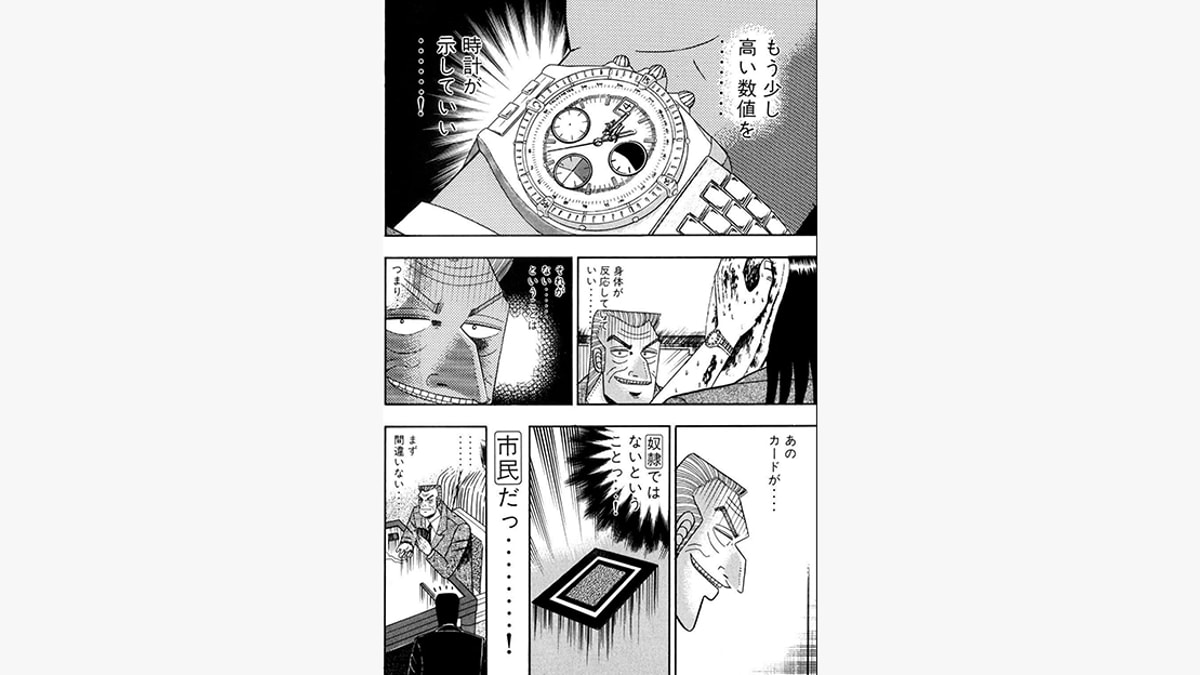
Tonegawa cheating his way through a high-stakes game, using the Chronomat (courtesy Kodansha).
The story of the underdog
Fukumoto likened his own plight to that of his character. Before he made it in manga, he saw his peers racing by him in life. “During the bubble economy, my friends were finding success,” Fukumoto recalls. “I tried making it as a boxer. But with two fights and two losses, it became clear that it wasn’t for me. I worked at low-paying construction jobs and couldn’t stand the idea of anything corporate. When I played with the idea of drawing manga, my friends told me I wasn’t good at drawing, and that I should just drop it.”
The underdog story—both in real and fictional life—is one that was echoed in a The Hollywood Reporter interview with Squid Game’s creator Hwang Dong-hyuk: “Back in 2008, I had a script that I had written, which I was running around with trying to get investment, but it didn’t work out and it wasn’t made into a movie. So that actually put me into a really difficult financial situation—I was broke. So I spent a lot of time killing time in comic book cafes, reading. And I read a lot of comic books revolving around surviving death games—manga like Liar Game and Kaiji.”
Both creators eventually wrote stories where their main characters had all odds against them.
Kaiji versus Tonegawa
As Fukumoto’s manga begins, the title character Kaiji is approached by the underworld organization Teiai and offered a spot in a “life-changing gamble.” Oblivious to the all-or-nothing implications, he accepts. Under mounting pressure, Kaiji proves himself incredibly talented and unstoppable when his back is against the wall, eventually facing off against Teiai’s frontman, Yukio Tonegawa—an elegant, well-dressed, highly-intelligent, and surprisingly likable villain—in a game called “E-Card.”
In the game, there are three types of cards: one Emperor (which the game is named after), four Citizens, and one Slave. The Emperor beats the Citizen, the Citizen beats the slave—but the Slave alone beats Emperor. This twist symbolizes how even those with nothing to lose can overcome the powerful—in this case, Kaiji the underdog versus the venerable Tonegawa.
Enter the Chronomat
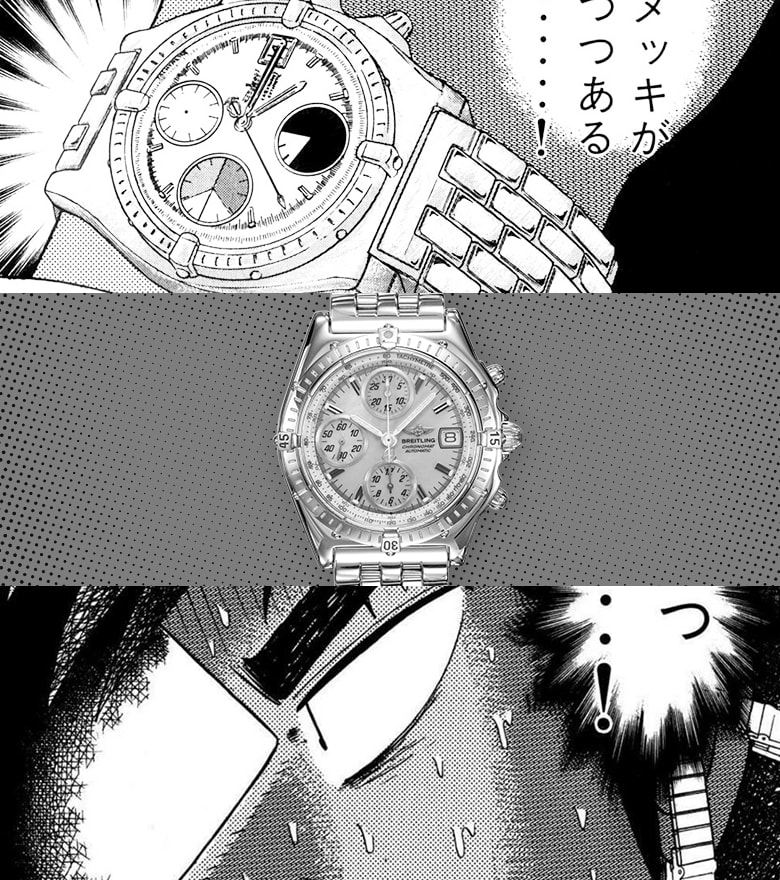
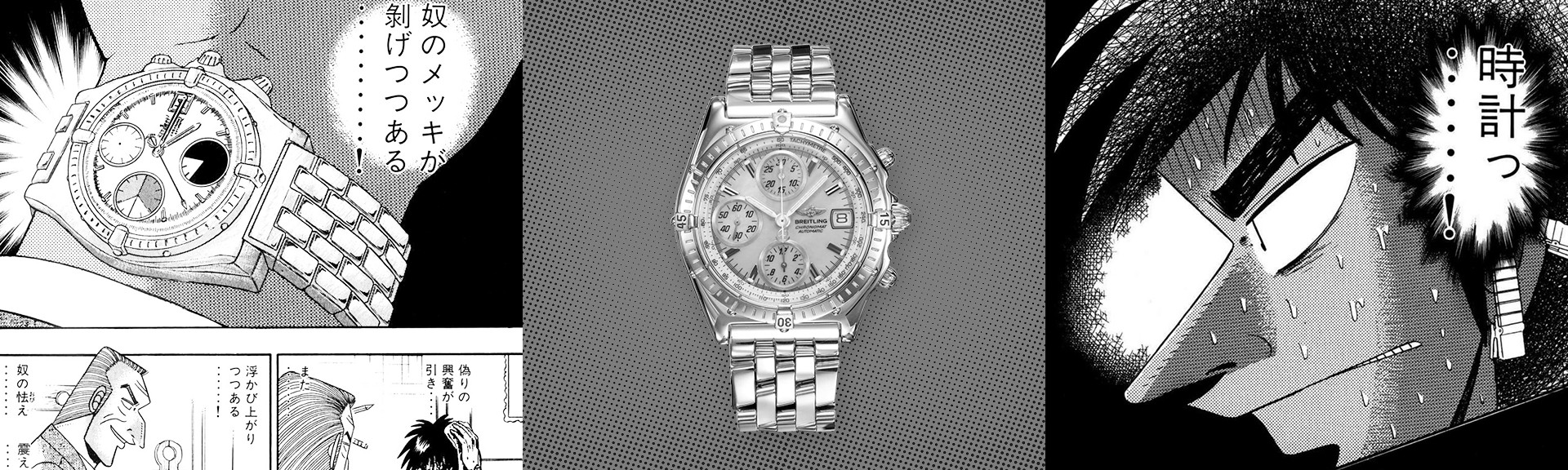
As cunning and experienced as Tonegawa is, fairness was never on the table. This is where Tonegawa’s Chronomat ref. 13050 comes in. Kaiji has a device fixed to his ear devised as part of the wager for the gamble. Little does he know, the earpiece is tracking his vital signs and displaying them on the three subdials of Tonegawa’s Chronomat: one for pulse, one for body temperature, and one for perspiration.
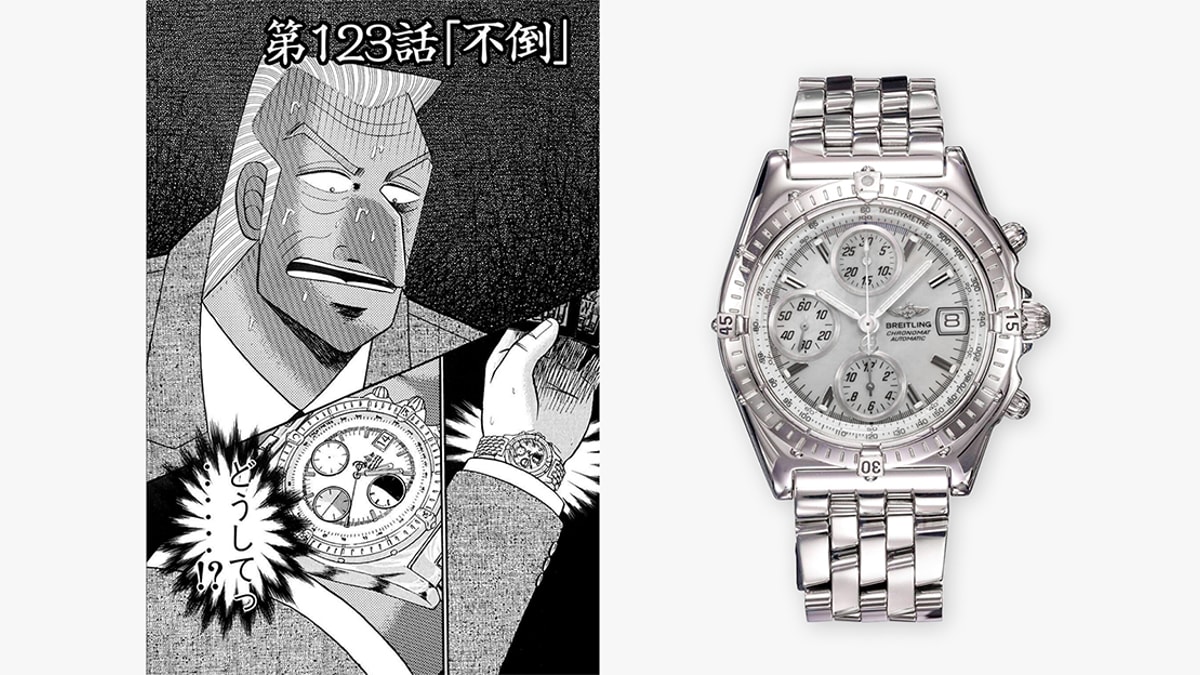
Left: Tonegawa shocked at Kaiji’s vital signs. (Courtesy Kodansha)
Right: real-life counterpart of Tonegawa’s Chronomat.
This secret weapon lets Tonegawa know when Kaiji will place the Emperor or the Slave card, which makes it easy to win every round. Kaiji however, notices something unusual: Tonegawa is wearing his watch on the inside of his wrist, allowing him to discreetly monitor Kaiji’s vital signs while holding his cards. Realizing the watch is being used to cheat marks a pivotal turning point in this all-or-nothing gamble.
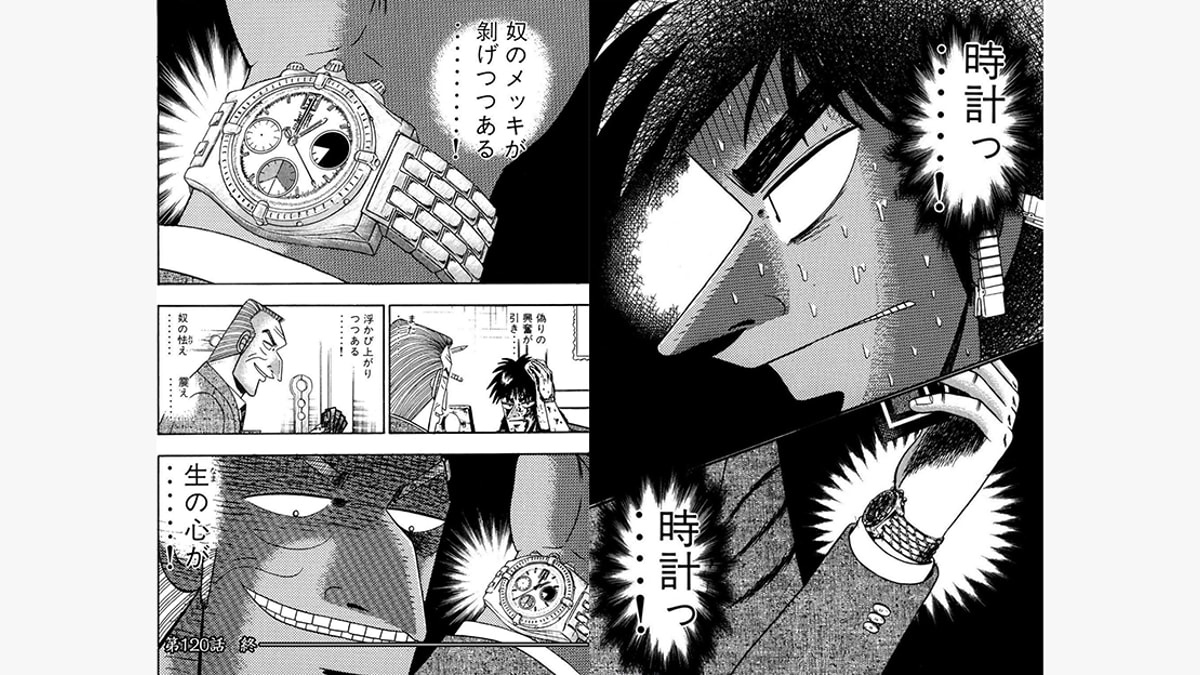
Left: Tonegawa monitoring Kaiji’s vital signs.
Right: Kaiji discovering Tonegawa’s cheating device. (Courtesy Kodansha)
“Upon brainstorming our options, I ultimately decided for a watch that matched Tonegawa’s prestige as a character,” says Fukumoto, when asked to revisit the choice he made in the late ‘90s, “and eventually I landed on the Breitling Chronomat. The chronograph layout lent itself perfectly to displaying Kaiji’s vital signs in his showdown with Tonegawa.” There were plenty of other choices at the time, but the bold-styled, avant-garde Chronomat was distinct and powerful, perfectly reflecting Teiai’s frontman.
All odds against the Chronomat
An underdog theme runs through each story: Slave versus Emperor, Kaiji versus Tonegawa, and the personal journeys of both Fukumoto and the Squid Game creator. It’s a narrative that defined the Chronomat’s own rise during what was arguably the darkest hour for the Swiss watch industry.
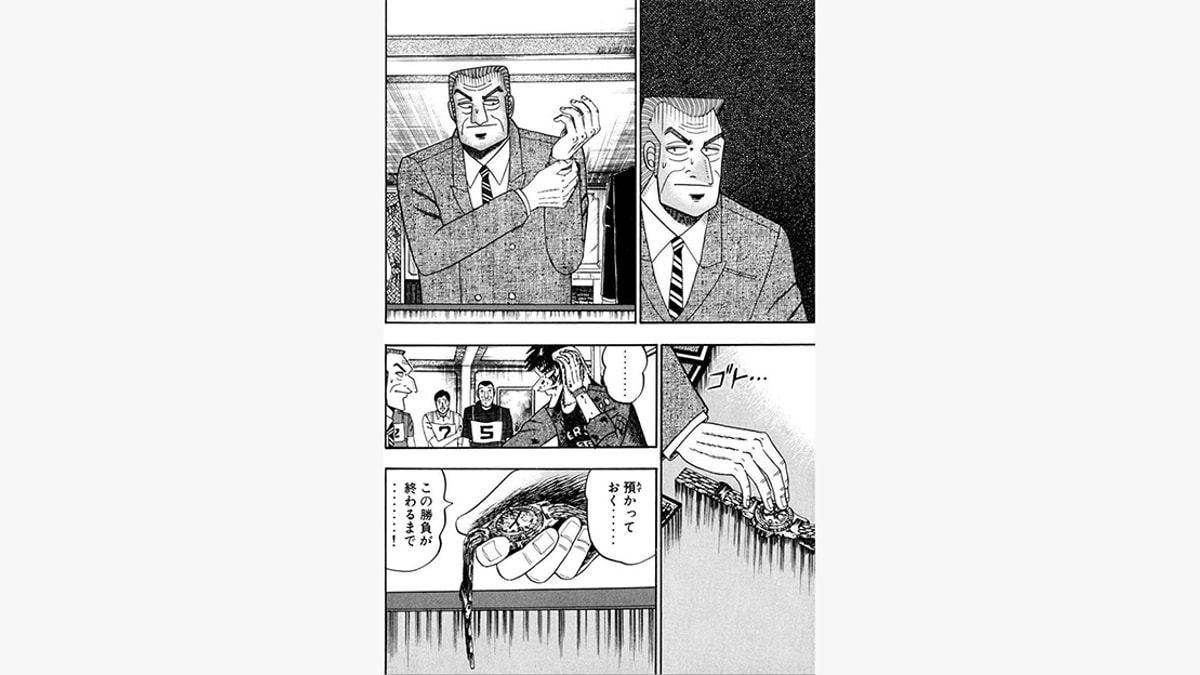
Tonegawa handing over his Chronomat upon being discovered. (Courtesy Kodansha)
In the late ’70s, all odds were against Breitling and other Swiss watchmakers. Traditional watch companies were either closing or being absorbed into larger groups. Inexpensive battery-powered quartz alternatives were taking over, and the entire industry seemed on the brink of collapse.
Despite these turbulent times, the Chronomat was launched under Ernest Schneider. Originally conceived for the pilots of Italy’s Frecce Tricolori aerobatic team, it stood as the antithesis of what was new: A mechanical watch, even using “automatic” as part of the name (short for “chronograph automatic”)—when most were shifting to battery power.
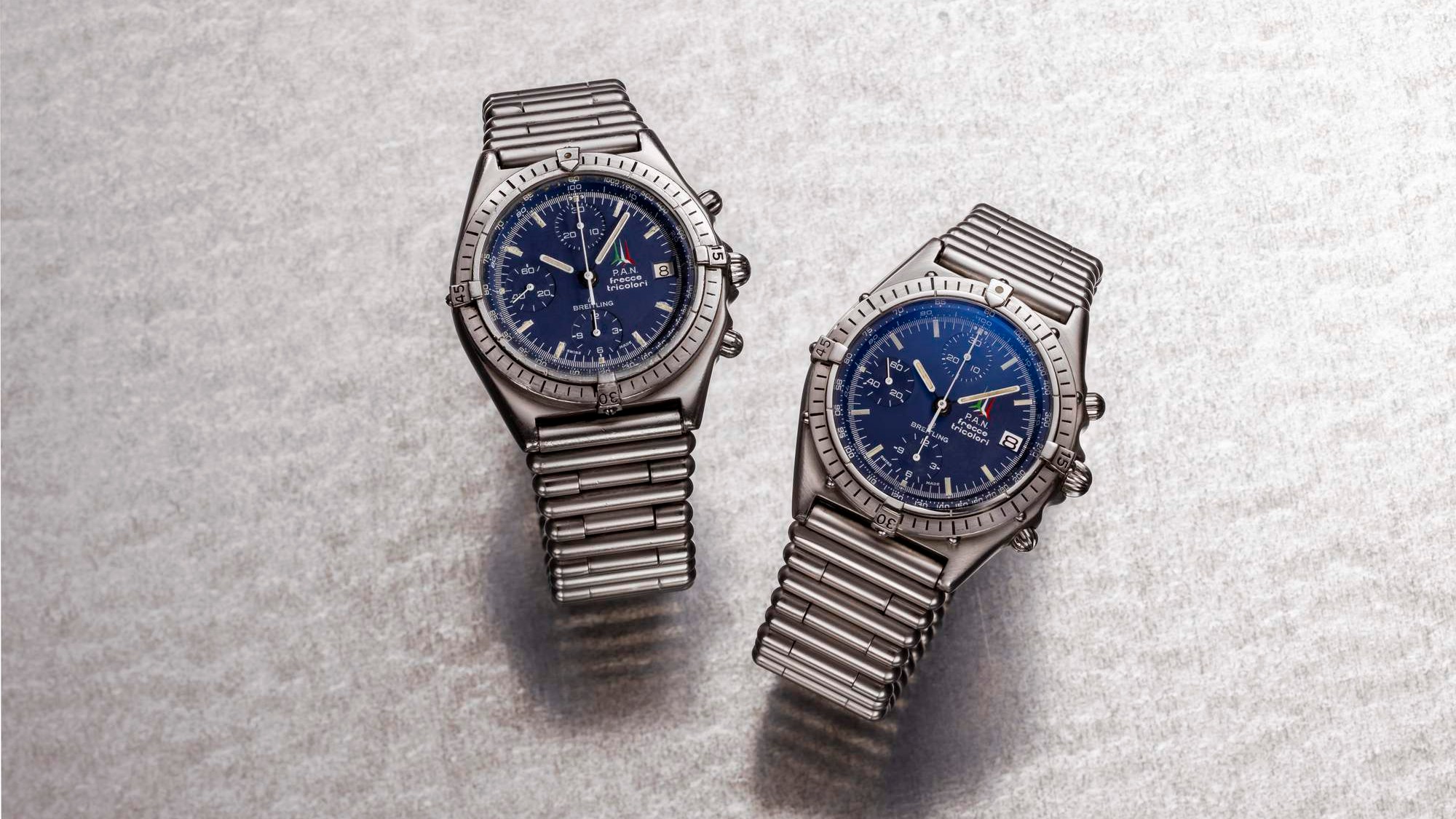
The “Chronograph Frecce Tricolori,” of 1983, the model that served as the blueprint for the Chronomat.
Gaining a following
Like Kaiji or Squid Game’s Gi-hun, the Chronomat overcame the seemingly impossible. Its appearance as a pivotal plot device in one of Japan’s most popular manga speaks to the respect it commanded—even in the relatively early days of the Chronomat line.
Today, it is one of Breitling’s most successful models. Its 200-meter water resistance, robust construction, bracelet or strap configuration, and timeless design make it popular with newcomers and longtime collectors alike.
Notable figures such as chef Gordon Ramsay, actor and comedian Jerry Seinfeld, and Oscar nominee Chazz Palminteri all frequently wear their Chronomats without any formal brand affiliation. Meanwhile, designer Victoria Bekham, NBA superstar Giannis Antetokounmpo, and pro football player Erling Haaland have chosen the Chronomat as their model to co-design.
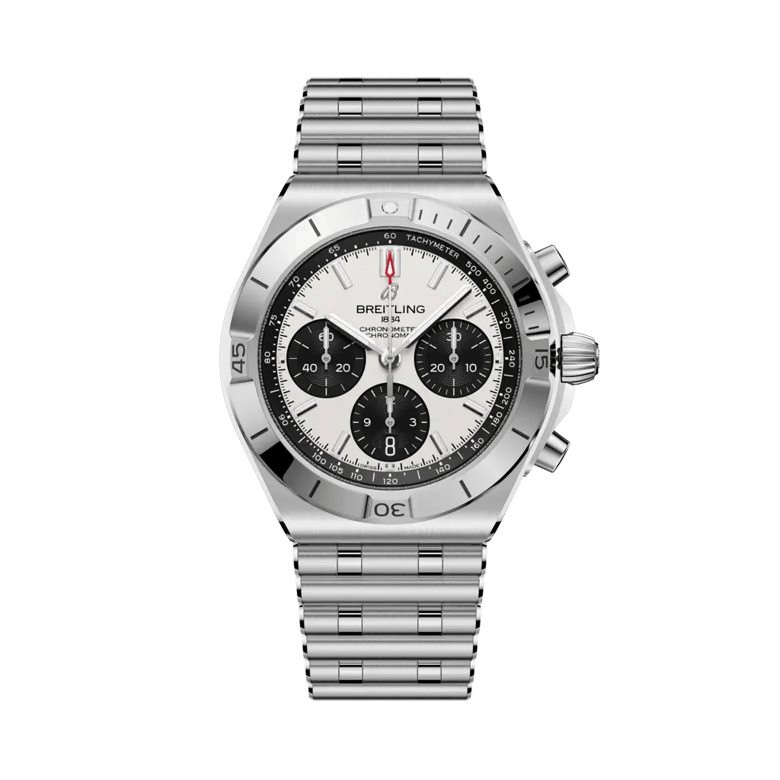
In May 2026, Breitling introduced a complete revamp of the Chronomat line. The 36 mm and 40 mm time-and-date models, as well as the 42 mm Chronograph now feature integrated bracelets, creating a seamless transition from case to bracelet. The bezel was also simplified, going from 18 components to one single piece, and the ergonomics were refined, improving comfort and wearability.
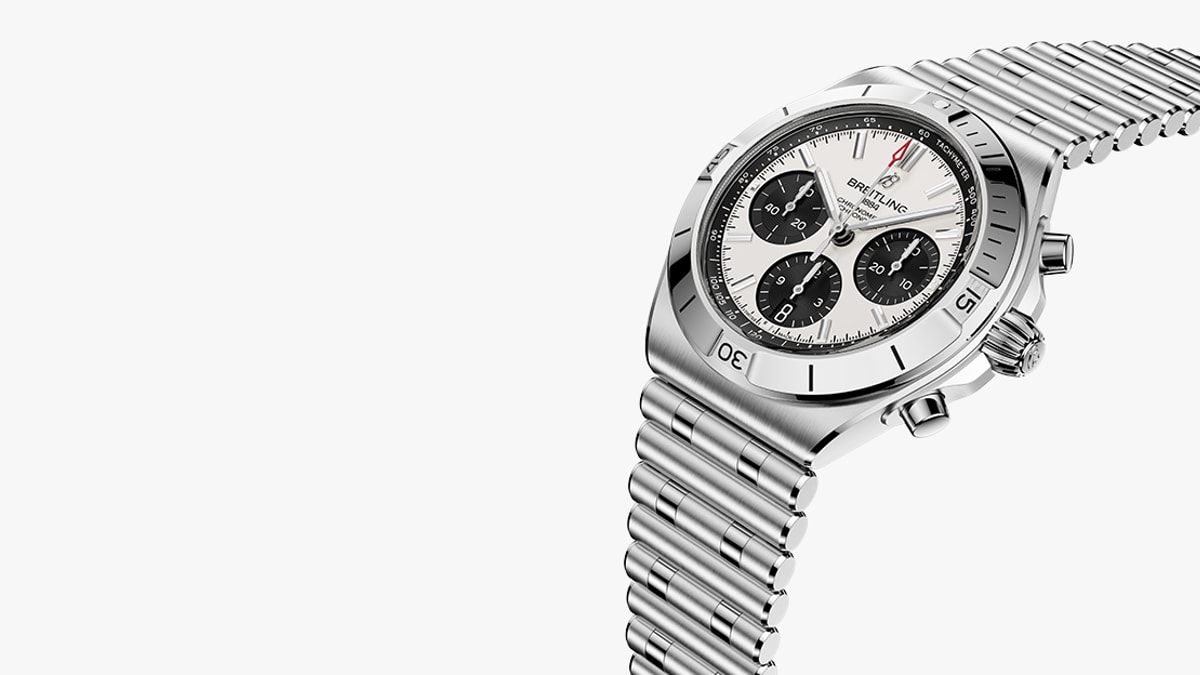
The new Chronomat, unveiled on 19 May 2026.
Being unveiled when all odds were against it, the Chronomat emerged, endured, and triumphed. With its back against the wall, Breitling played the right card at the right time. From the wrists of Italian jet pilots to a fictional character in a cult Japanese manga that helped inspire one of the world’s most popular TV shows, to global celebrities and athletes—the Breitling Chronomat has always endured.
Kaiji’s anime adaptation can be watched on Netflix or Crunchyroll, depending on the region.